|
|
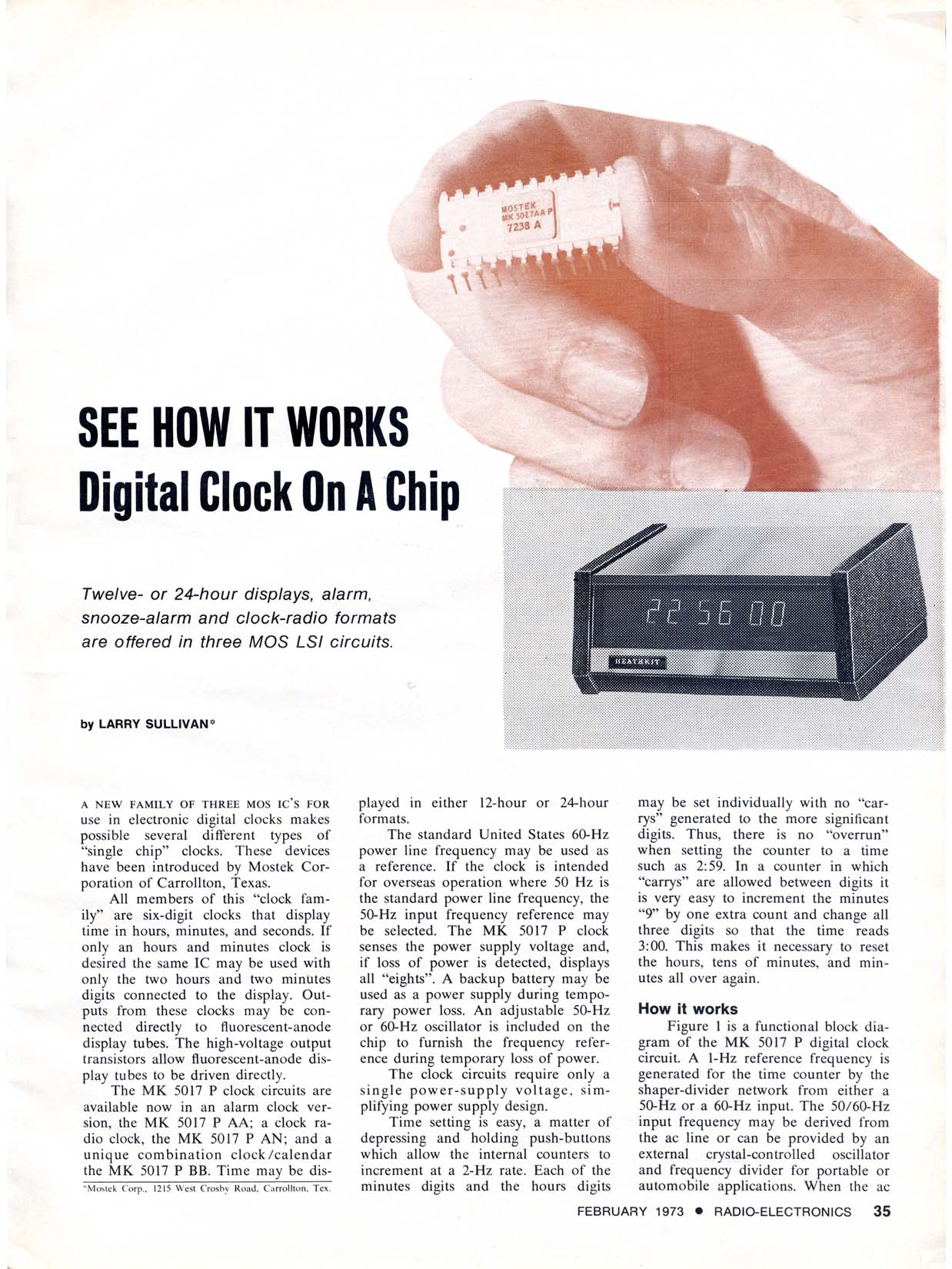
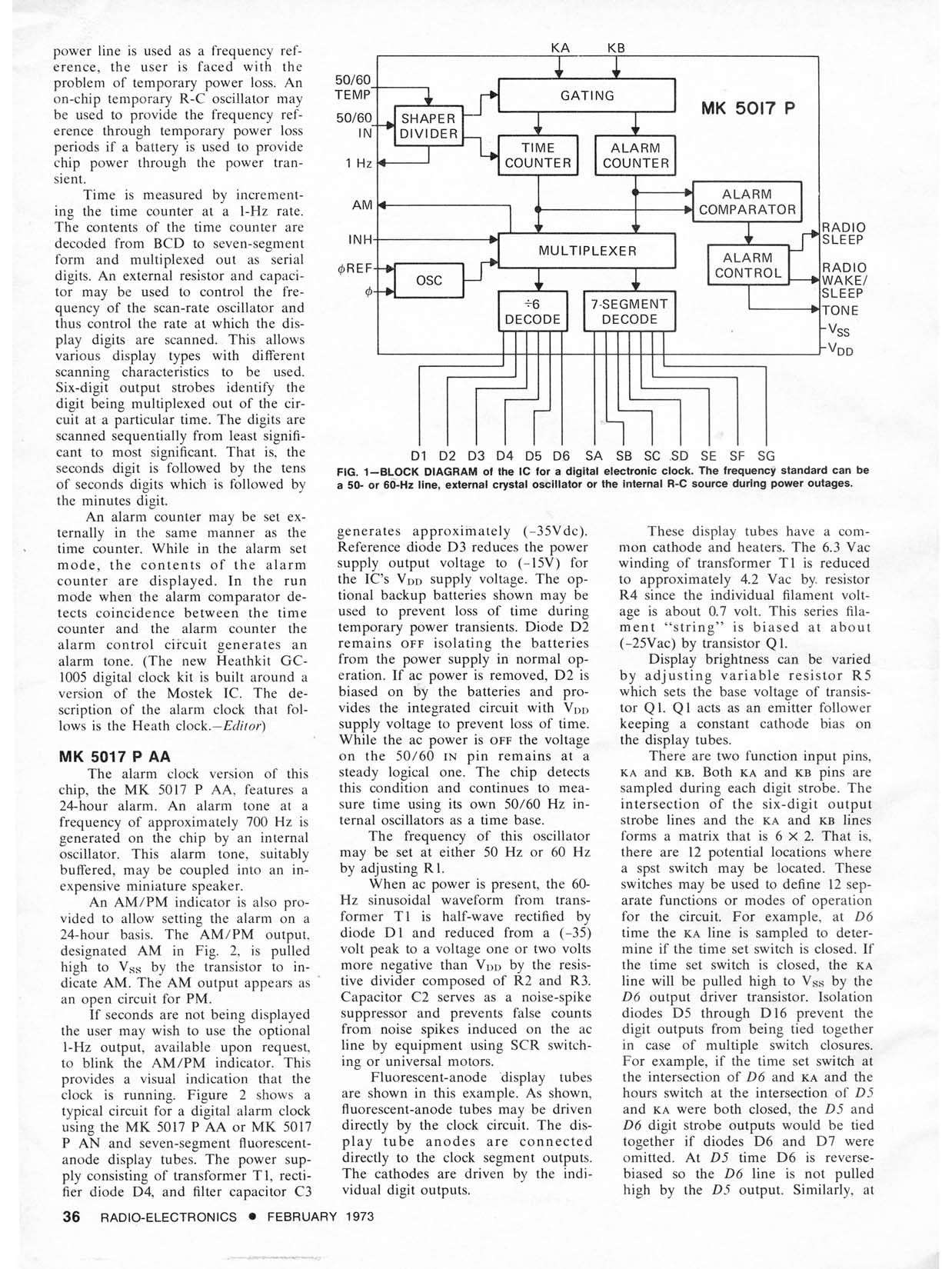
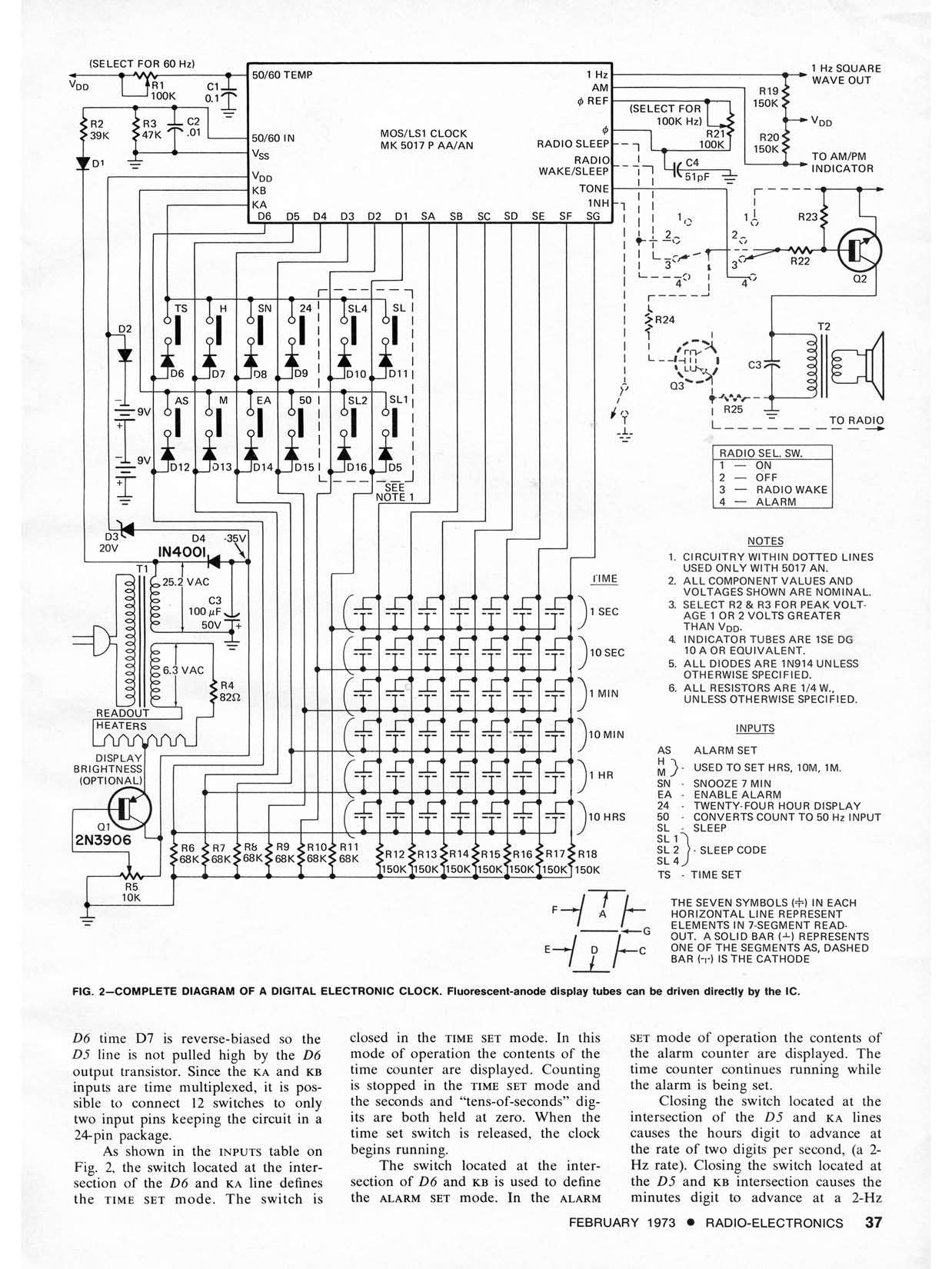
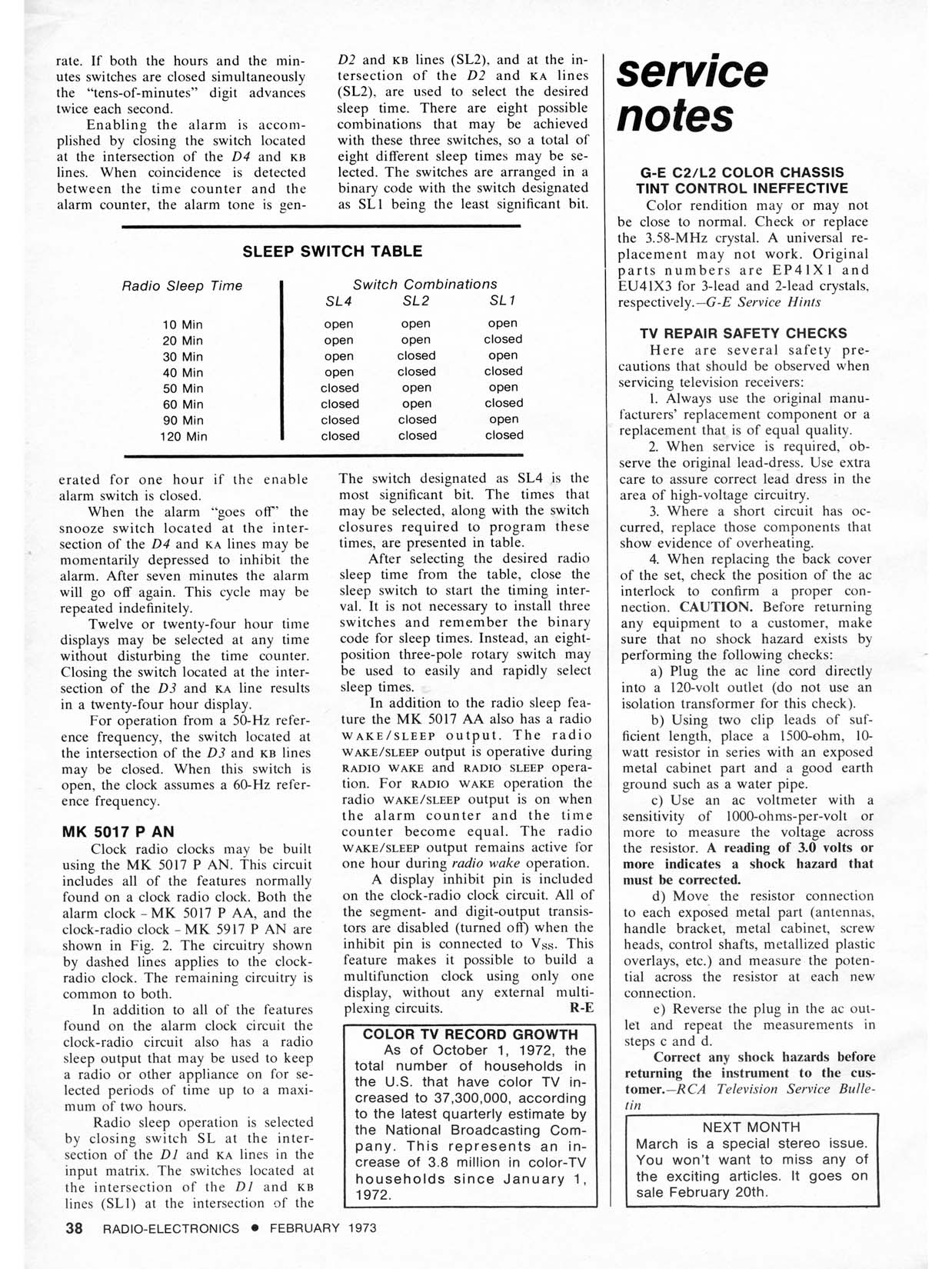
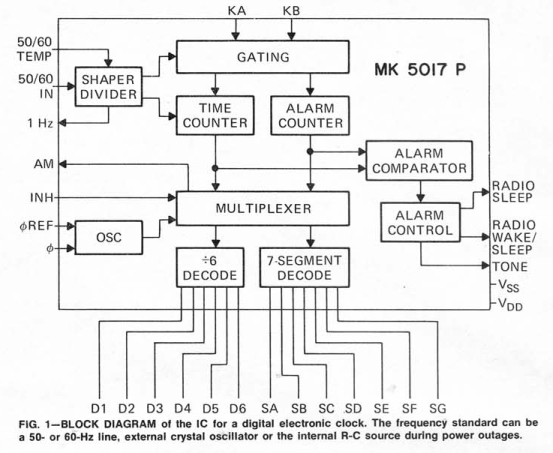
Time is kept from a Mostek MK5017 PAA integrated circuit. The 5017 had several variants (MK5017AA, MK5017P and MK5017A) but was always a 24-pin dual-inline package (DIP). It was Heathkit part number 443-601.
|
|
The clock uses three Sperry (Beckman) SP-352 two-digit gas discharge displays. These displays decay over time - you can read more about that here. The displays were designed to fit in matching sockets, the CS-352. Although not used by the GC-1005, Dionics made chips like the DI-770 (DI-770N) and DI-297 (DI-297N) that could drive these Panaplex displays.
|
|
These clocks are now four decades old, and one common problem that
seems to appear is a "flicker" in the display, especially when the
'1' digit is displayed. Replacing old SP-352 displays with new ones
seems to fix the problem, however some additional information appeared
in the Heath 1973 Technical Exchange Bulletin.
Change R204 from 8.2K to 15K.
Change C201 from 100 pf to 30 pfAfter these changes check to make sure the minutes set function advances the minutes as usual, that is; 1-2-3-4-5 etc. If the minutes advance 1-3-5-7-9 then change R204 to 18k or slightly higher until the minutes advance properly.
The best check for flicker is to set the clock to 1:11 and observe in a dark room.
Readers have also written with their experiences.
Just stumbled across your site and have some information about the flicker problem that you describe. I had the same problem with display flicker on my GC-1005. I would see flicker when a "1" or "7" was displayed. Swapping displays did not solve the problem. Changing the multiplexer timing circuit to the Mostek clock chip did the trick. For R204 I used 18k and for C201 I used 22pf. Play around with these values and I'll bet you can get the 1's/7's to stop flickering.
In checking your webpage on Heathkit Clocks I wanted to pass along some information that you may or may not already know.I just recently came across a GC-1092D with a display flickering problem.
I also came across a Heathkit Service bulletin regarding display timing and the RC combination of 18K + 30pF to the MK5017 clock chip.
Changing C208 in my GC-1092D from a 50 pF to a 30pF mica cap resolves the flickering problem.
|
|
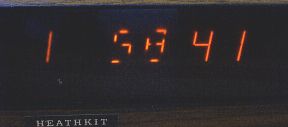 Other display problems include partial illumination, like the minutes and
tens-of-minutes seen here. This particular clock may have a bad MK5017,
since it occasionally "goes crazy" and displays minutes and seconds that
are out of order (non-sequential). Occasionally this results in seconds
that are greater than 59. Interestingly, the clock eventually recovers
and displays the correct time.
Other display problems include partial illumination, like the minutes and
tens-of-minutes seen here. This particular clock may have a bad MK5017,
since it occasionally "goes crazy" and displays minutes and seconds that
are out of order (non-sequential). Occasionally this results in seconds
that are greater than 59. Interestingly, the clock eventually recovers
and displays the correct time.
|
|
|
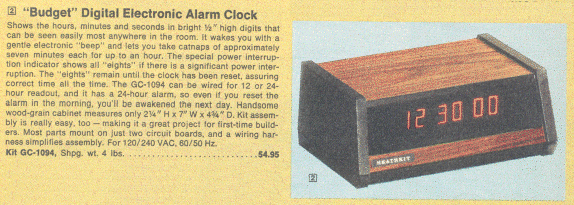
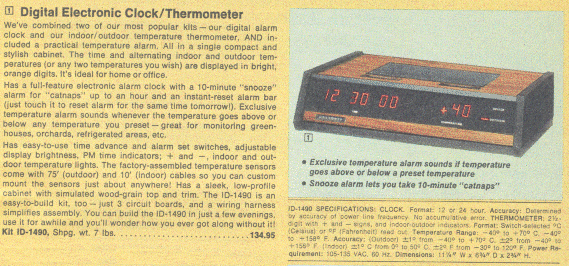
Click here to see an advertisement for this an similar clocks from the 1975 Heathkit catalog.
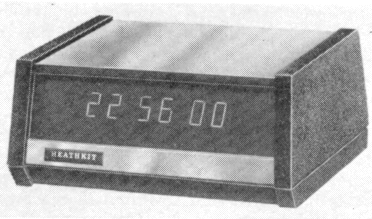 According to the hands on our old wall clock, it was a "quarter to nine"
when we arrived at the office to begin the workday. That is the way
most of us "read" time - after interpreting what is meant by
the various positions of the hands on the dial face, we put the
number of minutes to or after the hour first and follow with the hour,
forgetting the seconds altogether. But with the new breed of
numeric-readout digital electronic clocks on the market, one is
forced to tell time in the proper manner. So, a glance at our Heathkit
Model GC-1005 digital clock told us that our actual arrival time was
a more precise 8:45:36 a.m.
According to the hands on our old wall clock, it was a "quarter to nine"
when we arrived at the office to begin the workday. That is the way
most of us "read" time - after interpreting what is meant by
the various positions of the hands on the dial face, we put the
number of minutes to or after the hour first and follow with the hour,
forgetting the seconds altogether. But with the new breed of
numeric-readout digital electronic clocks on the market, one is
forced to tell time in the proper manner. So, a glance at our Heathkit
Model GC-1005 digital clock told us that our actual arrival time was
a more precise 8:45:36 a.m.
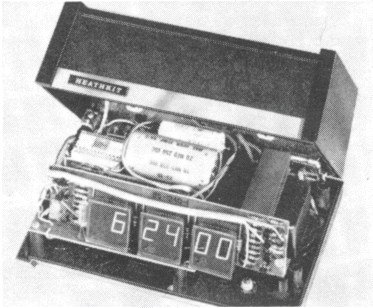 General Comments. Our Heathkit Model GC-1005 digital electronic
clock arrived in kit form. Having in the past assembled clock kits
built around a multitude of IC's and circuit boards, we anticipated
a long, tedious time of kit building. However, we were pleasantly
surprised to find that this was one of the easier kits in our experience.
After flipping through the assembly/operating manual supplied with the
kit and noting how few parts were to be mounted onto just two
printed circuit boards (one for the readout assembly, the other for the
logic and power supply), we were eager to get started. So, in about
4-1/2 hours, we had our clock ready for the acid test. Assembling the
kit posed no particular problems except that the MOS/LSI chip required
special handling to avoid damaging it through static electricity.
General Comments. Our Heathkit Model GC-1005 digital electronic
clock arrived in kit form. Having in the past assembled clock kits
built around a multitude of IC's and circuit boards, we anticipated
a long, tedious time of kit building. However, we were pleasantly
surprised to find that this was one of the easier kits in our experience.
After flipping through the assembly/operating manual supplied with the
kit and noting how few parts were to be mounted onto just two
printed circuit boards (one for the readout assembly, the other for the
logic and power supply), we were eager to get started. So, in about
4-1/2 hours, we had our clock ready for the acid test. Assembling the
kit posed no particular problems except that the MOS/LSI chip required
special handling to avoid damaging it through static electricity.