I don't think it was in a helicopter crash, since I know of only two Chicago officers who died in crashes:
- ("Flying Officer") Leonard Baldy, May 2, 1960 (while doing WGN traffic reports, details here); pilot George Ferry
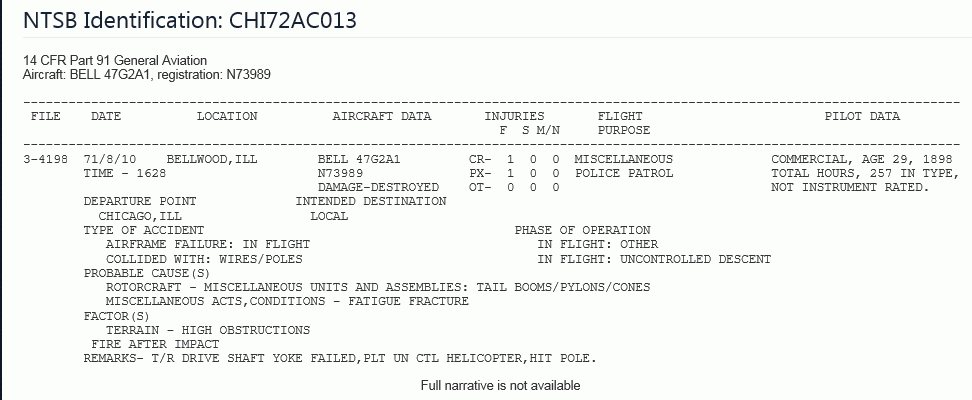
- ("Eye in the Sky") Irv Hayden, August 10, 1971 (in a WGN helicopter crash,
details here); pilot David Demarist
Chicago closed their two-helicopter operation in 1979.
From the Chicago Tribune, October 19, 1980:
Copter Flaw Seen in Crash
August 12, 1971Copter Flaw Seen in Crash
Malfunction of basic flight controls - possibly in the tail section - was identified yesterday by federal investigators as the probable cause of the helicopter crash in Bellwood Tuesday afternoon which took the lives of WGN's Flying Officer Irwin [Irv] Hayden, 52, and his pilot, David Demarest, 29.
"Weather was not a factor, although there had been thunderstorms, hall and lightning north of Bellwood where the accident occurred," said a National Transport Safety Board spokesman.
"The copter was in the clear away from the storm when the trouble started in the air. Scores of people on the ground saw what happened.
Rudder Difficulty Seen
"We are zeroing in on the copter control system and the power plant. We believe there was rudder difficulty. Cursory examination of the wreckage, however, indicates that both the main lift rotors and the tail yaw rotor were on the machine when it struck the power pole and burned.
"The difficulty seems to have been within the linkages and possibly the boost system through which the pilot controls the copter. It appeared to have occurred rather suddenly and the pilot, so far as we have been able to determine, did not make any radio report to the ground about his trouble."
Gene Filip, assistant news director of WGN, had been calling the copter from 4:20 to 4:25 p.m. to alert the two copter observers that their scheduled 4:35 p.m. broadcast was imminent. Hayden did not reply.
Crashed at 4:20 p.m.
Witnesses at the crash scene agreed that the helicopter struck the ground at 4:20 and was burning from its impact with a pole carrying high-powered electric lines.
"It's not surprising that the pilot did not make a radio report of the trouble," said Edwin L. Packer Jr., chief of flight operations for Chicago Helicopter Airways, which leases two helicopters to WGN each weekday for traffic observation.
"A comparison would be that the driver of a car would not make a radio report if his vehicle skidded a mile down an expressway. We have an open radio channel to all the traffic copters but our tape has nothing on it.
Pilot in Viet Nam
"We have pretty good indications of what happened, but the investigation is in the hands of the NTSB and we cannot discuss it at this time."
Pilot Demarest, Packer said, "had been a copter pilot in Viet Nam, and was a very fine airman." Packer said Demarest joined the Chicago Helicopter Airways staff in April, and was quite experienced in flying the Bell 47-G-2 single piston-engine copter.
Witnesses at the scene said the copter came over the Bellwood area at 200 feet or less "much below normal flight altitudes." They described it as "wavering uncertainly in flight," and as "appearing to have lost its power."
Spins Around Rotor
Several witnesses said that the helicopter began spinning "around its main rotor" just before it struck the 70-foot Commonwealth Edison pole, which carries both industrial and residential electrical lines with more than 50,000 total volts.
Hayden was making his second flight on his first day back at work after a month's holiday in Europe with his family. Hayden resided at 1536 W. Thome Av. and Demarest was living with two other pilots at 2700 N. Hampton Ct.
The accident was the second in WGN's traffic copter history. The first occurred in May, 1960, when Patrolman Leonard Baldy and his pilot, H. G. Ferry, were killed when another leased copter threw a main rotor blade and plunged into a railroad embankment at Hubbard Street and Milwaukee Avenue.
From the Chicago Tribune Magazine, August 12, 1971:
WGN, the only radio station with air spotters, sends two helicopters aloft during both the afternoon and morning rush hours. Flying officers Jim Cavanaugh of the Chicago Police Department and John Camden of the Cook County Sheriff's Police break into the drive-time programs eight times each in the morning (6:55 to 9:10) and evening (4:15 till 6:35). They also serve as spotters for IDOT [Illinois Department of Transportation], which knows when expressway traffic has become snarled but can't know why unless outside observers like WGN let it know.
Updates from 2004:
He's alive and well. He's retired and lives with his wife in a suburb just outside of Chicago.
and
As a committed 40+ year listener of WGN, I believe Cavanaugh is still doing traffic on occasion but is more or less a sub. I went to Gordon Tech High School in Chicago, just across the Chicago river from the (then) WGN radio studios, and because of my interest in radio (I later owned 4 stations) I remember WELL the days that both Baldy died (in 1960) and Hayden - in 1971. Hayden lived across the street from a music teacher of mine (I believe on Moody or Marmora St.).
From the Gainesville Sun, June 4, 1982:
CHICAGO (AP) - The pilot of a traffic helicopter said he had to swerve when a model airplane controlled from the ground came within 5 feet of crashing into his airborne chopper.Mike Davis, a helicopter pilot for 10 years, said he and Jim Cavanaugh of the Chicago police department were flying on traffic reporting duty for a radio station when the incident occurred at 600 feet.
They filed a reckless conduct complaint against the alleged operators of the model plane, Richard Grossman, 43, an accountant and model plane buff, and Greg Gruninger, 27, who flew chartered Lear jets for 3 1/2 years before recently becoming a pilot for Mississippi Valley Airways.
Gruninger, who is learning to fly remote-control models, and Grossman denied that the plane - a Sig Kadet trainer with a 57-inch wingspan and powered by a two-cycle gasoline engine - was in the air at the time of the alleged buzzing a week ago.
Grossman and Gruninger have a court date June 21 in suburban Palatine to face the misdemeanor charge.
Update from a reader, October 15, 2017:
I was trying to find exact dates "Flying Officer Jim Cavanaugh" worked for the Chicago PD and came up with your website.Jim is alive an (mostly) well. He lives in Arlington Heights, IL summers and Chandler, AZ winters. His wife Betty is also still alive.
He is a blast to talk to and should have been a comedian. I think he started with the CPD in 1956 or 1957. Retired late 1970's or early 1980's